
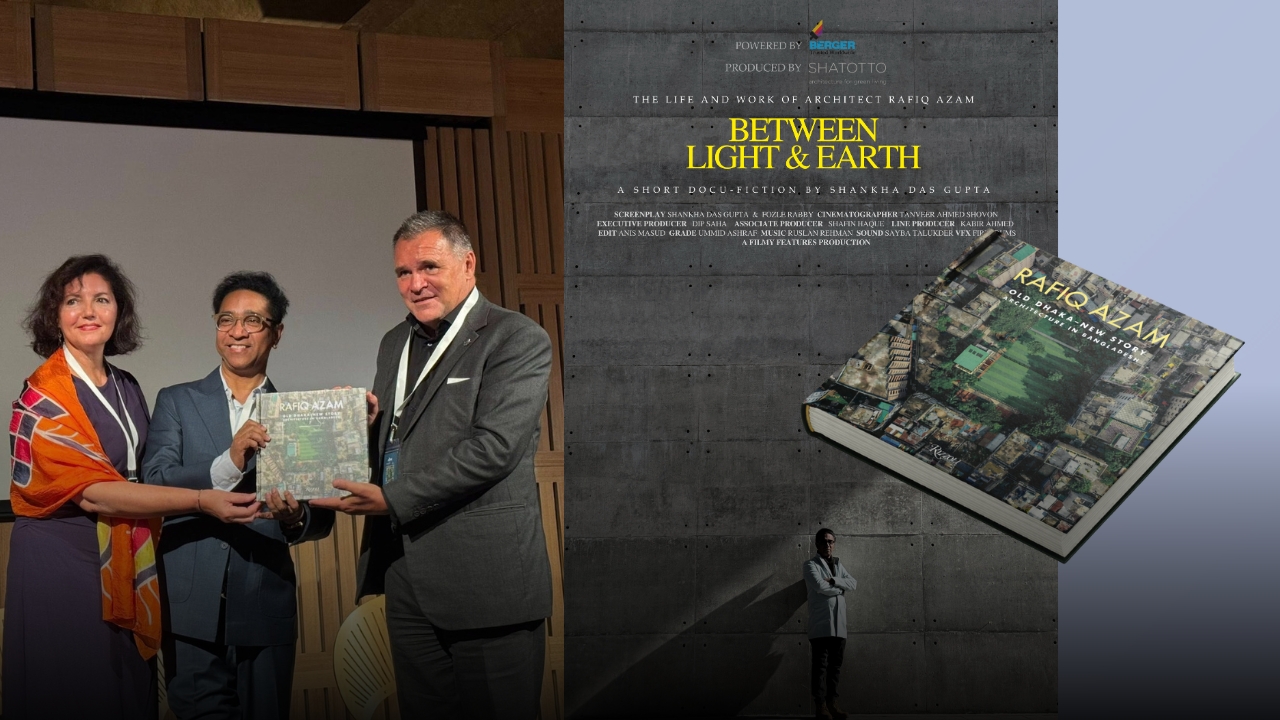
The groundbreaking monograph Rafiq Azam: Old Dhaka, New Story was launched on March 26, 2026, commemorating Bangladesh’s Independence Day, at the Utzon Room of the iconic Sydney Opera House.
The event also featured the world premiere of the docu-fiction film Between Light & Earth, directed by Shankha Dasgupta, which explores the life, philosophy, and architectural journey of architect Prof. Rafiq Azam.
The program brought together leading architects, professors, and distinguished guests from around the world. Over three hours, it highlighted Bangladesh, the evolution of Dhaka’s urban and architectural identity, and emphasized Azam’s design philosophy and body of work.
Renowned architect Glenn Murcutt, along with other speakers, underscored the promise of Rafiq Azam’s architectural vision and the philosophy behind Old Dhaka – New Story as a meaningful contribution to enhancing human well-being.

In the panel session, architect Zannat Jui shared her insights, saying:
"I have had the privilege of working with Azam over the years, and I have observed how deeply he engages with every layer and process in his work."
She added: "Old Dhaka is an ancient city with a history spanning over a thousand years, full of overlapping layers of development, heritage, and culture. To truly understand and work in this city, one must navigate all these layers. While working on projects in Old Dhaka, we faced significant financial challenges. Yet, for the first time in our life and professional partnership, I saw Azam genuinely happy. I realized that while these projects aim to benefit the community, ultimately, he undertakes them for himself."
The book, published by Rizzoli Publications, recounts the journey of Rafiq Azam, who eventually established the renowned architecture practice Shatotto.
It features an in-depth conversation with editor Maria Rosa Falvo, alongside essays by distinguished architects and scholars including Kenneth Frampton, Shamsul Wares, Fuad H. Mallick, Philip Goad, and George Kunihiro. Bringing together these varied perspectives, the book positions Bangladeshi architecture within a broader global conversation on culture, creativity, and contemporary design.
The book is set to be released in 42 cities across 23 countries in upcoming phases.